


MORTIIS
GHOSTS OF EUROPA
PROPHECY PRODUCTIONS
JUNE 26TH, 2026
REVIEWED BY: JASON DEAVILLE
REVIEW SCORE: 9
THE SETUP
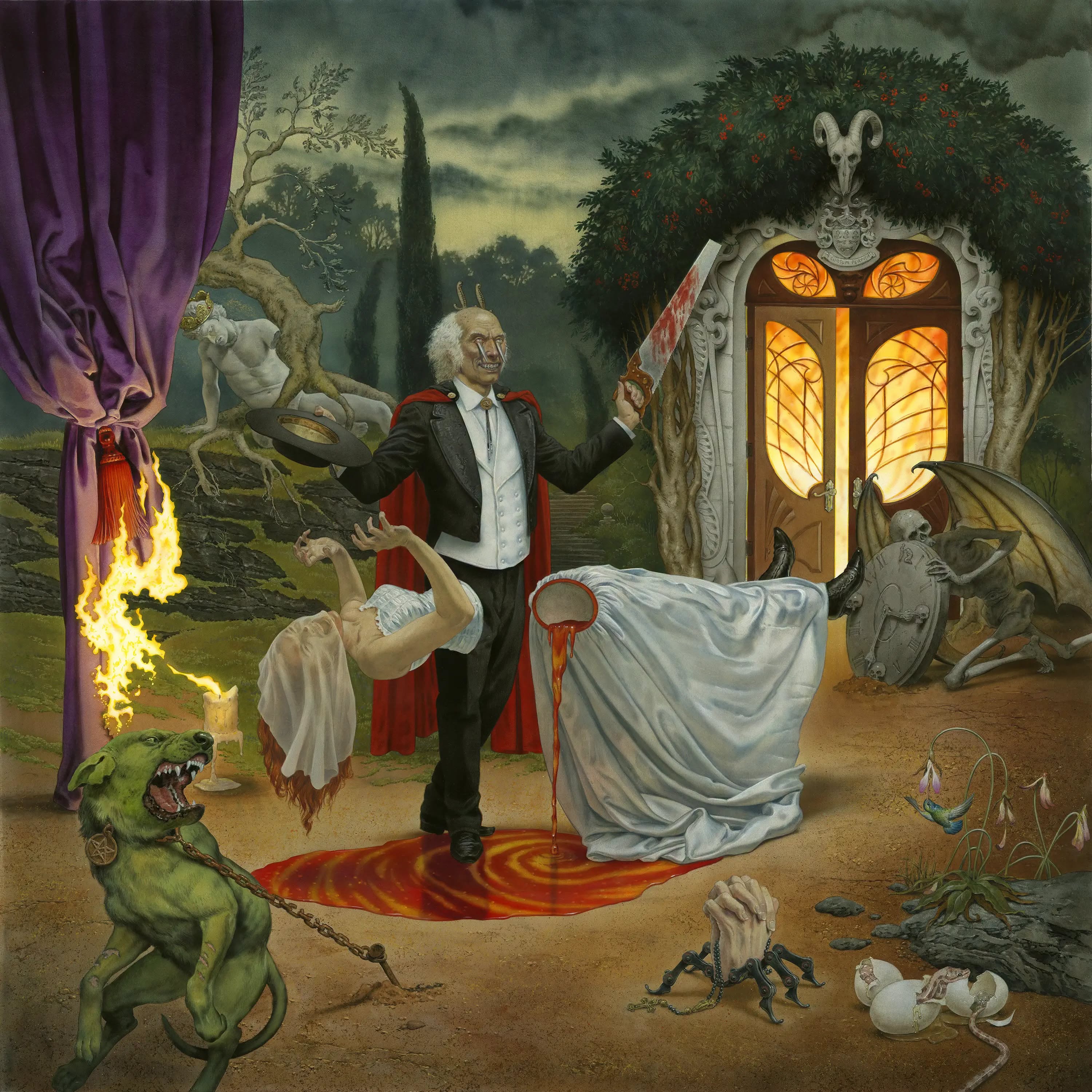
Six long years of silence, and Mortiis is finally back with what is easily his most expansive, cinematic, and darkly dystopian album to date; an album born from intense soul-searching and personal struggle. To really appreciate how monumental this is, one has to delve back into his ever-evolving persona and art, stretching all the way back to his 1991 roots as the founding bassist of Emperor, to single-handedly blueprinting the entire Dungeon Synth genre in Era I, to the heavy industrial rock and electronic mutations that followed over the decades. This newest material actually started as a collaborative project with Stephan Groth of Apoptygma Berzerk, fueled by a mutual fascination with old German electronic wizards such as Tangerine Dream and Klaus Schulze. But when that partnership fell apart, Mortiis pushed forward alone, obsessively transforming, warping, and mutating those early recordings into bleak, desolate, and timeless alien landscapes. It was an agonizing process that came at the cost of friendships and relationships, but it has resulted in a richly detailed work that is unlike anything else. It’s the sonic testimony of a seasoned artist honouring every phase of his past while boldly stepping into spaces where he has never existed before.
THE REVIEW
‘GHOSTS OF EUROPA’
Is this the best Mortiis track since 2001’s ‘Parasite God’? After a few spins, I would likely answer with a resounding YES! Whether it will stand the test of time, as the aforementioned track has, remains to be seen. At its core, it is a strange, mysterious, and deeply choral electronic rock song that, to these ears, pays homage to the late, great Edgar Froese (founder of Tangerine Dream). Mortiis has perfectly captured the melancholic, isolated, and alien atmospheres of Edgar’s 1975 solo album, Epsilon In Malaysian Pale, more specifically the track ‘Maroubra Bay’. Both are built around a hypnotically pulsing analog sequencer loop. The connection to this vintage world becomes even more prevalent with the inclusion of Tangerine Dream‘s Thorsten Quaeschning, who contributes synths and sequencers on the track. The song also features guest choral/vocal arrangements by Sarah Jezebel Deva (Cradle Of Filth) and Laurie Ann Haus (World Of Warcraft, Starcraft 2, Diablo 3).
As moody and cosmic-horror-fuelled as this song sounds, there is also a definite contemporary edge, evident in the use of some extreme vocal pitch correction (Auto-Tune) combined with a gated vocal vibrato. This vocal technique is often heard in the music of pop artists such as Post Malone and daine. The latter is well known for her vocals that are passed through a dense wall of pitch-quantizing software and digital distortion, which are then layered over trap beats and ambient soundscapes. Similarly, passing Mortiis‘ naturally raspy, dramatic vocal delivery through modern pitch-quantizing software creates an unsettling stylistic clash. Instead of sounding like a pop radio hit, it warps his voice into something deeply unnatural, cold, and cyberpunk-y. It works incredibly well and adds a bleak, high-tech, and darkly dystopian vibe to the eight-minute journey.
‘RETURN TO THE OLD FIELDS’
If there is one track in recent memory that bridges the gap between neoclassical darkwave and primordial Northern folk perfectly, it is this song right here. While the framework is darkwave (à la Dead Can Dance ), the spirit of the song is pure Nordic ritualism, directly evoking the ancestralism of acts like Wardruna and Danheim. The song gets much of its droning tribal rhythm from the E-bow and guitar work provided by Vegard Blomberg (Mock), who does a great job of making it feel ancient. For lovers of Mortiis‘ dungeon-synth days, this song definitely exudes some of that cold, damp atmosphere found on Født til å herske, yet as you move deeper into the dungeon, the synthetic weight of an 808 bounces off the walls, hitting you straight in the chest like a shockwave. Very cool stuff.
‘THE FAITH THAT FADES AWAY’
This is what happens when you take the pop-infused, structured sanity of Pretty Hate Machine and throw it into a cosmic blender with the dystopian synth-punk of Front Line Assembly. It is controlled chaos. This would rest comfortably alongside Era III stuff, as it definitely has an edge to it we’ve heard on The Grudge (2004) and The Great Deceiver (2016). Where it differs is the mix. This is much deeper, with the electronic elements showcasing a sleeker Euro club kinda vibe.
‘VIOLENT SILENCE’
And here we have the album’s first direct throwback to the 80s. In fact, had this track dropped in ’85, well, Mortiis woulda found himself at the top of the DIY post-punk of the European underground, alongside revered acts such as Trisomie 21, Invisible Limits, Asylum Party, and Absolute Body Control. This is a total fucking earworm of a song that perfectly executes the minimal wave and coldwave stylings of Depeche Mode at their darkest (circa their ’86 album, Black Celebration), and Clan Of Xymox‘s Medusa (also released in 1986). ‘Violent Silence’ is perhaps the most danceable Mortiis track yet, with a highly hip-shaking four-on-the-floor synth-pop/coldwave backbeat.
‘TRANSCENDING MORPHEUS’
The track immediately brings to mind Ulver’s cinematic work, specifically their scores for 2003’s Svidd Neger and 2016’s Riverhead. Much like those soundtracks, it leans heavily into experimental and dark ambient territory, with subtle touches of Nordic and Celtic folk. But right around the midpoint, the song undergoes a substantial shift, transitioning from the realm of moving pictures into a heavy, driving backbeat that brings the black-lace-enshrouded masses to the goth club dance floor.
‘TUNDRA, HEART OF HELL’
Every album has an anthem, and this is undoubtedly Ghosts Of Europa‘s. The vocals are the star of the show, with the melodies front and centre, delivering a massive, accessible hook that sticks in your head long after the track ends. The brilliance doesn’t end there, as the entirety of the track swirls around a synth pad riff that gives the main riff in Emperor‘s ‘I Am The Black Wizards’ (a song Mortiis had a hand in creating) a run for its money. Just like that famous Emperor tremolo line, the synth riff is utilized to create a hypnotic melody that instantly sticks in your head. There is a specific kind of genius in creating incredibly catchy yet nihilistic black metal tremolo melodies, and this synth riff captures that magic perfectly.
‘TRIBES OF DYSTOPIA’
This is a crushingly heavy, bleak cyberpunk anthem that uses massive walls of distorted, fuzzed-out synthesizer tones to mimic the crushing riffs found on any Norwegian black metal album. This is the same approach that James Kent of Perturbator utilizes, and it’s perhaps why the music of both Mortiis and Perturbator appeals to so many metalheads. The entire track is anchored by a deliciously retro-sounding 16th-note arpeggiator or sequencer loop, which gives it an infectious, Perturbator-like, neon-lit synthwave energy.
‘FAREWELL ROMEO’
Definitely the heaviest track on the album, from a rock or metal perspective. Though not outright metal or rock, the listener is hit with a massive wall of both ambient, distorted guitars and swelling synths that, when paying close attention, might remind one of Nine Inch Nails‘ ‘Hurt’ (from The Downward Spiral). If this wasn’t enough, there is also a minimalist dread to the song that recalls the cinematic, slow-burning ending to a John Carpenter movie.
THE VERDICT
When we talk about Mortiis, we often talk about the various eras. And yes, there are certainly distinctive musical snapshots or ‘eras’ that we could use to describe the man and his art… but Ghosts of Europa serves as the crossroads where those distinct creative timelines seamlessly converge into a brilliant, unified front. By melting his legendary past into a cinematic landscape of infectious 80s coldwave and synthwave, cosmic Berlin School electronics, and the occasional caustic industrial groove, Mortiis has achieved absolute creative liberation, delivering his most visionary, deeply personal, and musically mature album yet. This is the kinda stuff most artists only dream of creating.