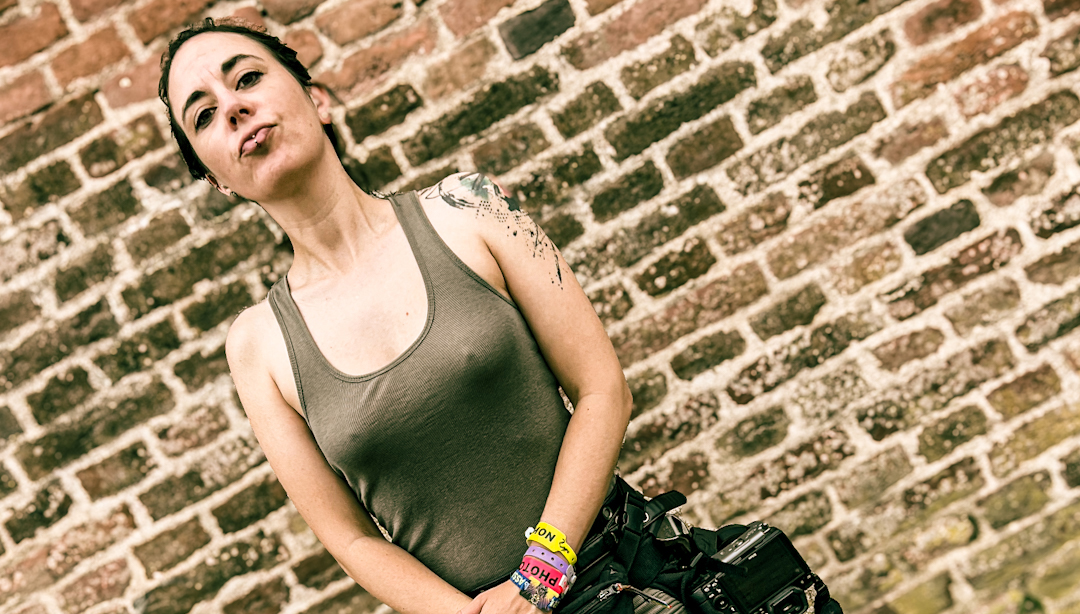



AFRA CATHARINA
‘afrarina_metal1info‘
Germany
‘Try to get in contact with a magazine, do the small gigs, the dark club shows. Nergal once told me, “You gotta eat shit before you get cake.” And, Take. Your. Time. Concert photography isn’t something you learn over night.‘
Every concert photographer has a story about how they first found their way into the pit. How did your journey begin, and how has it evolved over the years?
I got into a relationship with someone who wrote for Metal1.info, including concert reviews and we started to go to shows together. When I occasionally met some concert photographers I thought “Hey, those guys are pretty cool.” My partner had the opportunity to get photo passes as well when he applied for accreditations.
I had an old Panasonic Bridge camera (I don’t even remember which one, but the highest possible ISO was 400 haha) and after I had a test run with a band I was friends with and the photos turned out ok I suddenly found myself in a small club shooting Solstafir, that was back in October 2014. After that I decided to get a better camera, it was a Sony A58, so still DSLR for beginners and a proper lens and that was it.
I was in the privileged position to shoot for a magazine right from the start that made it a lot easier to get accreditations. Over the years I got better gear and better contacts and learned a lot but besides that it feels like not much has changed. I consider myself lucky to still be a part of the Metal1.info-family.

Being the house photographer at a festival means you’re not only documenting the performances but also everything happening behind the scenes. How do you balance the fast pace of backstage life while making sure you don’t miss those great moments on stage?
I think my most important hack is that I make the running order of the day my lock screen. And it’s really important to know the venue, all the short cuts from one stage to another, the green room, the catering, where the smokers will be, that kind of stuff. It helps a lot if I am not tied to the 3-song-rule (thanks to the promoters who offer me this opportunity) because that way I am more flexible and can take a minute if I see a good motive while I am just running to the next stage. And the better you know a band the better you know when something you don’t want to miss might happen. But in the end I just have to make my peace with the fact that I can’t be everywhere at the same time and while I capture one moment I will miss three others.


Your Instagram has become much more than a gallery of finished photographs. You regularly share reels about photography life, the challenges, the funny moments, and the reality behind the work. What inspired you to start opening that door for people?
Well, in the beginning I thought about the Instagram page as some kind of portfolio where I just showed my best photos. But then it shifted to my most recent photos which naturally had a lot in common with the Instagram page of Metal1.info and I decided to make it a bit more personal, show my face at least from time to time, give some insights into editing and different situations concert photography can come with so people can get an idea of who I am. And as I myself enjoy funny memes I just post some myself whenever something comes to mind.
Concert photography often looks glamorous from the outside, but those of us who do it know it’s usually long hours, heavy gear, little sleep, and a lot of problem solving. What’s something you wish more people understood about the job?
For many of us it doesn’t pay. Like at all. Those who shoot for their own page or an online magazine most of the time don’t see any or only little money. So no, we can not live off this. We still have a day job. So the shooting, the editing, that happens during our free time driven by our love and passion. It’s different when you work as a tour photographer, of course, but I know still photographers touring their asses off and getting paid not nearly enough to live without worrying about where next month’s rent will be coming from. And yes, there are concert photographers that are so popular they can choose their jobs and get paid very well but that’s not the majority – just like most bands, it’s hard to make a living out of this and everything we put into we do it out of passion. Not for the money but for the art.


As someone who photographs countless bands every year, how do you keep yourself creatively engaged instead of falling into the same compositions over and over?
Well, sometimes I think I fall into that trap, especially when it’s a band I shot before and they are trying to maintain a special way to present themselves. If the band’s aim is to reproduce the exact same show perfectly every night it’s not surprising if all photos look the same. But while I have to work with the costumes, the poses, the lights, the visuals, the props the band chooses, I always have an impact on where I stand, what I focus on, which angle I choose etc. The moment I realize “Hey, I already took a thousand photos like this over the years” I try to make a change, whether it’s a step back or forward, or I bend the other way, or – if I don’t realize until I’m editing – I choose a different color scheme etc. And it always helps me to keep looking at other photographers’ work, not to copy them but to get new inspiration. “What do I like about their work? How would I do something like that? What don’t I like and how would I do it instead?” you know, stuff like that.


Every year at the Dark Easter Metal Meeting, visitors have the chance to see your work in an exhibition. For photographers who have considered displaying their work, what goes into putting together an exhibit? What are some of the logistical, financial, and creative challenges that you face?
There is so much you need to think of besides “Which photos should I show?” and many of these things just pop up way too late when you do it the first time: how – like physically – how can I hang my pictures: is there a wall I am allowed (and able) to put nails in or do I need another solution? For example at DEMM nails are not an option – I get a site fence: the first year I used cord and almost had a meltdown because it was so tricky to hang all photos at the same height… so next year I came back with chains instead which made it a lot easier. And you should always always always have tie-wraps and duck tape. How is the light in the space of the exhibition (not a problem in a classic gallery but can be tricky at a festival), do I need to bring extra lamps? Do I need frames?
I personally chose frames that weren’t very expensive so that it’s not that big of a loss if something breaks. Instead I chose a more expensive print-option and that money was really well spent – just some weeks ago a couple of my prints got a bit wet because our basement flooded but after I dried them carefully, you couldn’t even tell where they had been wet. Honestly, I could do a whole interview on just everything I learned during putting up these exhibitions.
Seeing a photograph hanging on a gallery wall is a very different experience from seeing it scroll past on social media. How do you decide which images deserve to become prints?
I always try to think of the exhibition as a coherent whole. If I would choose just maybe 12 or 15 of my favorite photos it could happen that they don’t look good next to each other. The photos have to speak to each other – sounds a bit esoteric but what I mean is: there need to be color schemes, contrasts, lines of sight that connect the single photos to each other. So besides some kind of topic – at Dark Easter Metal Meeting I always choose photos of bands that have either played there before or are playing there in the year of the exhibition – I think you also need some kind of aesthetic connection between the photos.

Every photographer has that one piece of gear they simply couldn’t imagine working without. What is yours, and what makes it indispensable?
My camera holster belt. Wearing my gear exclusively on my hips and not on my shoulders is non-negotiable for me. As long as I had just one camera I was wearing it in a hip-bag, but when I switched to using two bodies I decided to invest in this hip-holster-belt-thing. It did cost as much as my first camera did but as my shoulders and neck get tensed super easy it’s the only way for me to carry that much gear around.
Looking ahead, are there any personal projects, festivals, artists, or creative goals you’re especially excited to pursue over the next few years?
I love to capture moments that happen off the stage be it backstage or in the crowd and I still have to push myself every time to go the extra mile, like get into the pit after the first three songs or ask a band if they are comfortable with me hanging around and taking some behind the scenes shots, but it’s always worth it and I will try to do this more often. Besides this it’s more like going with the flow, see what comes up, what shows get announced, who I get to know better.
I am really excited for the Iron Roses in October because their shows create such a wholesome safe space and Becky and Natasha are the most beautiful souls, it’s a privilege to join something like this with my camera.

Looking back at your earliest concert photographs, what’s one thing your younger self did really well and what’s one habit you’re glad you’ve left behind?
I think I still profit from my unconventional start. When I started concert photography that was when I started photography. I didn’t know anything about camera settings or editing. I asked a friend who had done concert photography for the best settings and luckily he knew what he was talking about so I could stick to his tips for a long time. But no one told me anything about editing except “You should get Lightroom.” So I got Lightroom and then I figured out which slide was doing what while using them. I just moved them back and forth until I saw things changing the way I wanted them to. And that’s still pretty much how I use it: of course with a lot more intention but sometimes I get a raw and I have no idea what to do with it and then it’s just slider-roulette again until something changes in a way I like 😀
I am glad I stopped complaining about light. The lights at a show are an aesthetic choice just like my setting and editing choices. They can be art. Their purpose is not to make my work (or art) easier. That doesn’t mean that there is no bad stage lighting – sometimes you can just see or feel that the light tech has no high standards and just wants the evening to be over or that neither band nor tech has a clear vision. But low lights or just red and fog can still be very aesthetic and some light techs create beautiful art but that doesn’t always come with easy photo conditions.

Years spent photographing live music inevitably leads to unforgettable moments. Is there a particularly wild or unexpected story that you’d like to share?
One of the first things that comes to mind happened just last year. I shot In Flames in Kufstein and decided to go crowdsurfing with the camera because it was a crowd (and security crew) I could trust. So I chose a song where Anders Friden told us “Throw your friends in the air” because everyone would be extra aware of crowdsurfers. I got some nice shots of the crowd but with the lights being basically red, the photos of the stage weren’t usable. But I attended another In Flames show on this run a couple of weeks later, and I asked a friend in the crew “When will it be bright?” “Well, during “Trigger” but that’s when everybody’s jumping…”. I did it anyway and let me tell you: Shooting while crowdsurfing when everyone is jumping and not everyone is expecting a crowdsurfer comes with its challenges. But In Flames have such a supportive audience and I made it through the whole venue and got some nice pics out of it.

Do you have a favourite photograph you’ve taken? If so, is there a story behind it that makes it especially meaningful to you?
That’s really difficult to answer because I’m torn between “I like so many of my photos” and “No, in the end they all could still be better.” But there is one photo of Lena Scissorhands with Infected Rain that I like for different reasons: first of all she looks so much in the moment. Editing this one was pretty tricky because I didn’t get her hand in the photo so it wasn’t easy to crop it in a good way and I ended with this completely black background so you don’t even think of a concert photo at first. And I was in a pretty bad place during that time and was able to forget that at least during those first three songs, so it reminds me that you can still have light moments in a dark time.

You’ve built a reputation for openly sharing both the successes and the struggles of concert photography. Why do you think it’s important for photographers to support and learn from one another rather than treating everything as a competition?
Because I think most of us got into this out of passion and for the sake of art. That’s something we all have in common. And no one is perfect, there is always something someone else might do better than you and vice versa, so if we share our hacks and ideas and resources we might all get more out of it than we put in. This fucked up capitalistic world is already nothing but a competition, I don’t need this in my photography safe space as well.


Finally, what advice would you give to someone who dreams of becoming a concert photographer, or to someone who’s already shooting shows and wants to take the next step?
Try to get in contact with a magazine, do the small gigs, the dark club shows, Nergal once told me “You gotta eat shit before you get cake.” and: Take. Your. Time. Concert photography isn’t something you learn over night. You can watch tutorials and read blogs and listen to podcasts and do online training but in the end every show is unique, every venue is different, every band and every crowd is different and so you learn something new with every show you shoot. And it is okay if you are into this for two or three or four years and you are not yet where you want to be. That is not a long time and there are still so many shows waiting for you. Just enjoy the ride.
See more of Afra Catharina’s work:
https://www.instagram.com/afrarina_metal1info/
https://www.instagram.com/metal1.info/
https://www.facebook.com/Metal1.info
https://www.metal1.info/author/afra-gethoeffer/
Author: Kimberly Baarda (baardafoto)